Scholarship Tax Credit
What Impact Will the Federal Tax Credit Have on Public Education?
A Harvard panel discussion

Leading voices in education policy discuss “The Next Phase of School Choice: What Impact Will the Federal Tax Credit Have?” — a compelling session from Harvard Graduate School of Education’s 2026 Emerging School Models: Broadening the Landscape for Choice conference.
Hear from Kim Anderson (NEA), Derrell Bradford (50CAN), and Greg Nadeau (Ed3) in a robust panel discussion moderated by Daniel Hamlin (UT Austin) and Paul E. Peterson (Harvard University).
📅 Recorded September 17, 2026 👁️ 1 hour 13 minues
Don’t miss this critical conversation about the new federal scholarship tax credit program.
Mercante explains FSTC
Most Delawareans are not aware about the benefits of a new law that goes into effect Jan. 1, 2027. And what little is out there is not well understood. In this 18-minute clip, C4DS’ Nancy Mercante talks with Rick about how it will work if Delaware decides to participate.
EdChoice survey finds strong support for the FSTC
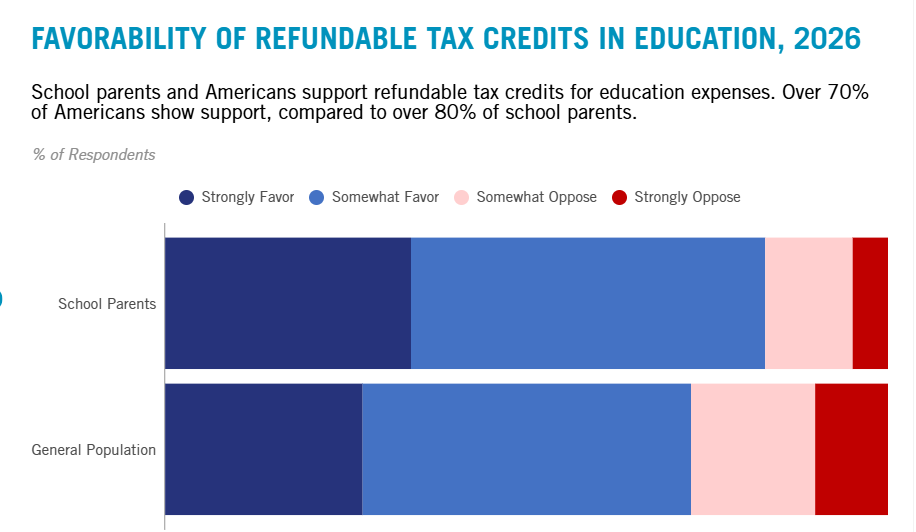
In EdChoice’s Schooling in America Survey from the spring of 2026, parents expressed overwhelming support for refundable tax credits to cover education expenses.
Even 70 percent of Americans not classified as school parents said they supported the concept.
Another interesting finding was that while half of public school parents say they would choose another option for their children, roughly 80% of students still attend public schools.
Questions & Answers about the Federal Scholarship Tax Credit
These Q&As are a collection of most commonly asked questions and represent responses created by many of the groups involved with the program specifics and rule-making. These include American Federation for Children, Commonwealth Foundation, and the Coalition for Federal Scholarship Tax Credits.
As new information becomes available, it will be posted here.
Delaware’s governor has until December 31 to join the program. If he does not, then Delaware students will not be eligible for scholarships created by the FSTC.
The Q&As are divided by sections to make it easier to navigate.

Introduction: Official overview of the U.S. Department of the Treasury and IRS regulations under Internal Revenue Code Section 25F (Education Freedom Tax Credit).
The Basics: Details on credit limits ($1,700 individual / $3,400 joint), nonrefundable tax credit vs. deduction mechanics, 5-year rollover rules, and program distinction from traditional vouchers.
Student Scholarships: Expected funding levels, Delaware participation scenarios, eligibility (up to 300% AMGI), qualified educational expenses (tutoring, special needs, supplies, technology), and award determination.
The State’s Role: Governor opt-in rules, non-revocation policies, strategic reasons not to delay until 2028, out-of-state SGO contributions, and limits on state restrictions.
Scholarship Granting Organizations (SGOs): 501(c)(3) public charity requirements, 90/10 allocation rules, public school district opportunities (District Bundled Services & Employer-Led Payroll Deductions), and clarity on public tax dollar protection.
Implementation Timeline: Key milestone dates for comments (Dec 1, 2026), public hearing (Dec 15, 2026), launch (Jan 1, 2027), and 6-step rollout timeline through Summer 2027 disbursements.
- Last updated: 11/21/26
It is a federal tax credit program that allows individual taxpayers to make private cash donations to approved Scholarship Granting Organizations (SGOs) in exchange for a dollar-for-dollar nonrefundable federal income tax credit. SGOs turn these contributed funds into educational scholarships for eligible students in K-12.
Individual tax filers can claim a dollar-for-dollar nonrefundable tax credit on their federal tax bill of up to $1,700 per tax year. Married taxpayers filing jointly can claim a combined credit of up to $3,400 per year. The credit is claimed in tax years after 2026. You give first; the credit reduces your federal tax bill when you file.
Many charitable donations qualify for a tax deduction. These tax deductions reduce your taxable income, which means the actual savings are a fraction of what you gave. For example, if you’re in the 24% tax bracket and claim a $1,700 deduction, you save about $408. That’s it.
A tax credit, on the other hand, reduces your actual tax bill, dollar for dollar. Rather than giving your full tax payment to the IRS, you’re redirecting a portion of it to a cause you care about. For example, if you donate $1,700 to a qualified scholarship granting organization (SGO) and owe $2,000 in federal taxes, you now owe $300. Your tax liability decreases by $1,700, not $408.
If your credit is more than you owe in federal taxes for the year, the unused amount can generally carry forward for up to five years.
No. A voucher generally helps pay private school tuition and are funded by state governments. Net cost of this program to state budgets: $0. The FSTC is federal tax law and the US Treasury sets the regulations. The FSTC scholarships are funded by private donations that earn donors a federal tax credit. The Treasury regulations make clear that public students qualify for the scholarships.
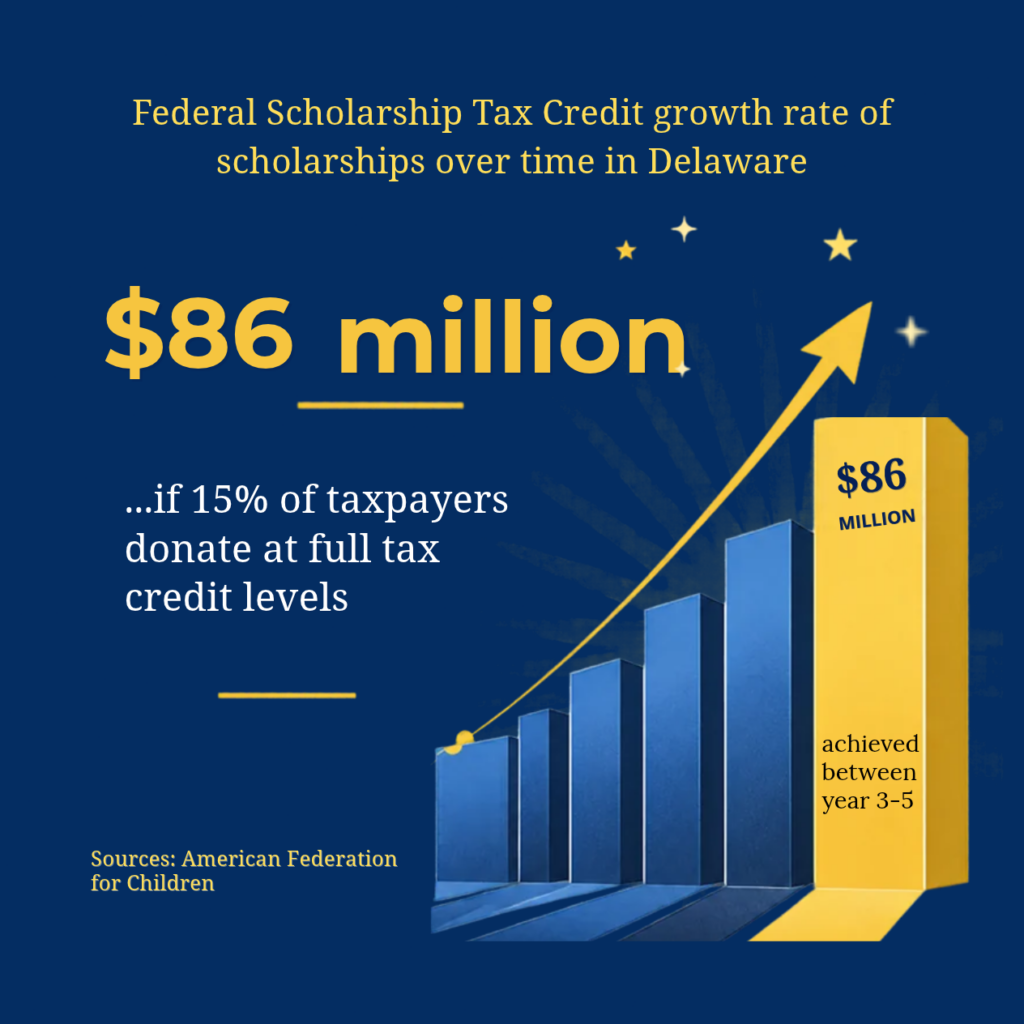
Millions of dollars could be raised depending on taxpayer participation. Delaware has 156,000 federal taxpayers who could give the max $1,700 individual or $3,400 for joint filers. Education Reform Now projects that if 15% of these taxpayers participated, more than $86 million can be raised for student scholarships within 3 to 5 years.
Josh Cowen, a professor of education policy at Michigan State University, says that based on similar state programs elsewhere, people will give. It will be more challenging for Delaware at first because the state has never set up this kind of program. Three important actions are needed:
- A concerted public awareness effort to get the word out across the state.
- The ability to set up scholarship granting organizations to receive donations and hand out scholarships. Starting early will be particularly important for those in the public school community who want to set up a SGO. Qualifying SGOs must be approved by the state by February 15, 2027. At that point, they can start accepting donations.
- Employers who make it easy to give through payroll deductions.
Not until the governor opts in and submits an approved SGO list to the IRS. After that, it depends on when SGOs secure enough donations to fund scholarships starting with the 2027-28 school year. If the state doesn’t opt in, Delaware students will be ineligible for the scholarships.
Students eligible to attend K-12 school settings recognized by the state of Delaware. Their household income cannot exceed 300% of their Area Median Gross Income (AMGI). This represents 90% of Delaware K-12 students. SGOs must verify household income during the application process using standard federal guidelines outlined in the Treasury rules.
Although the eligibility ceiling is broad by design, not all students will receive a scholarship. We expect many SGOs to focus on the needs of lower to middle income families who need extra help that they can’t otherwise afford to pay themselves.
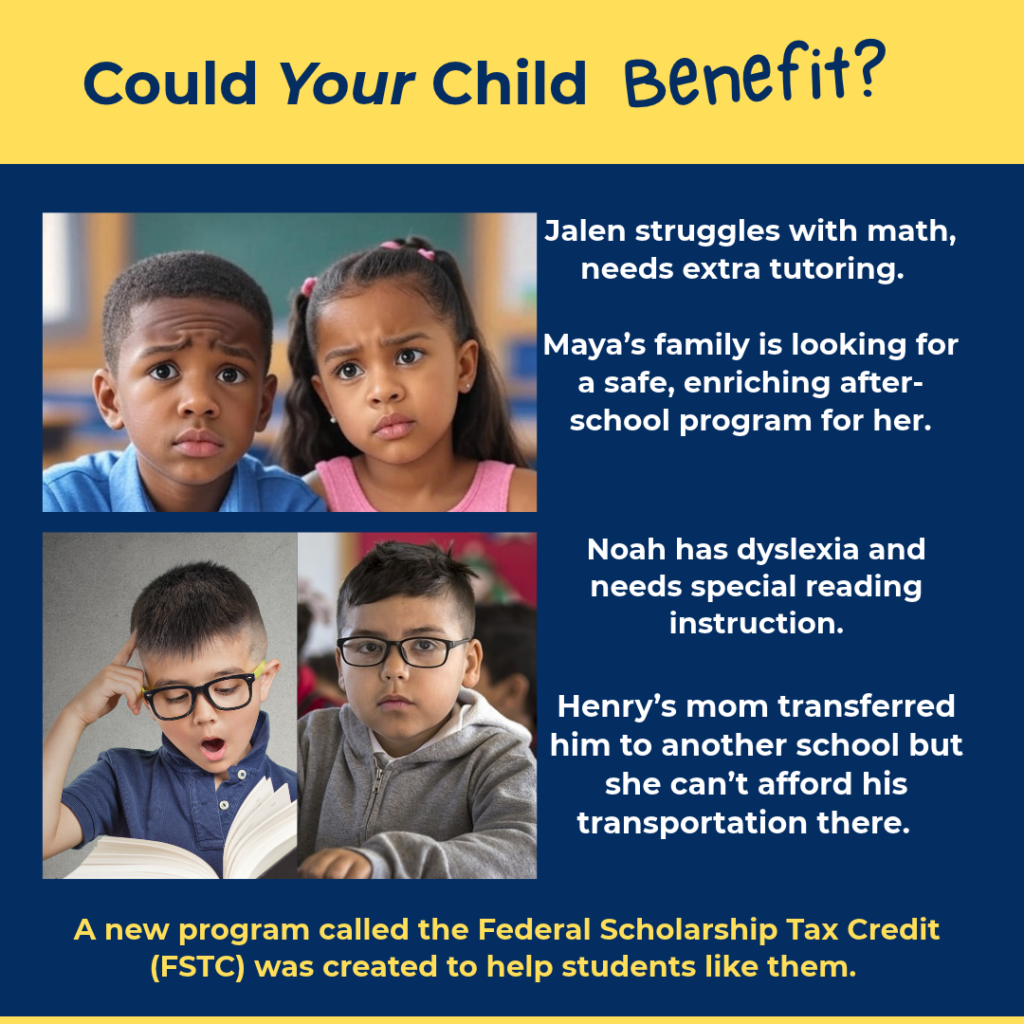
Scholarships are not restricted solely to private school tuition. Treasury has confirmed that scholarships may cover additive academic tutoring and special needs services, which is important for families whose children need more support than what’s available in their current school. Under Treasury rules, qualified elementary and secondary education expenses include:
- Private school tuition and fees
- Academic tutoring services
- Special-needs services and therapies
- Textbooks, educational materials, and school supplies
- Computers, hardware, and educational technology
- Fees for standardized testing or college entrance exams
We expect a set of rules by the end of this year that lay out requirements for service providers to qualify for scholarship funds.
The scholarship awards are different than the tax credit limit of $1,700 and could be more or less, depending on the applications received and cost of services requested.
No. Participation is voluntary with the final decision resting with the governor. He has until January 1, 2027, to opt in, and then must provide a list of certified SGOs that can operate in the state. If he doesn’t do both, Delaware students will not be eligible to receive scholarships.
No. Once a State completes its election for a calendar year, it cannot revoke it under the temporary regulations. The State must make a new election and meet all requirements each calendar year. There are two required steps that must be completed:
- The State must submit its required State SGO list and certifications by the deadline. If it doesn’t, then no organization in the State qualifies as an SGO for that year and the opt-in is void.
- Once the advance election is finalized upon the state certification of SGOs, or the election is made together with that list, the Treasury Department and IRS state that section 25F does not permit revocation for that year.
It might be tempting to wait a year and start in 2028, but it’s important to note that the tax credit scholarships are only authorized by Congress through 2029. Delaying even one year to get started puts public schools at real risk of missing out on some of this opportunity.
Not only would schools forgo a year’s worth of funds, but taxpayer decisions and SGO relationships could form around other recipients. Also worrisome is that by waiting, a state wouldn’t be able to tap what is sure to be a big national push to get taxpayers signed up.
Yes. Donors can still benefit from the tax credit by contributing to SGOs in states that have opted in.
No. The state has two primary roles: choose to participate and submit its approved state SGO list to the IRS by the deadlines.
A state cannot arbitrarily block or discriminate against a national or out-of-state SGO if the organization meets all standard federal 25F requirements. For instance, states cannot bar SGOs from issuing scholarships to private religious schools, nor can states dictate specific scholarship allocation priority beyond federal guidelines (such as prioritizing previous year’s recipients and their siblings).
However, approved SGOs can specify an area of focus, such as vocational education. The state must explicitly include the SGO on its registry so the IRS can verify that donations earmarked for that state’s students are valid.
- Be registered Section 501(c)(3) tax-exempt public charities.
- Allocate and spend at least 90% of their total income directly on K–12 scholarships.
- Register electronically via a new IRS portal and issue formal donor acknowledgments by January 31 following the contribution year.
- Submit to annual program and financial audits to maintain inclusion on state and federal SGO registries.
Yes, provided they meet specific requirements. Several national SGOs are planning to offer their services to state-based groups and provide the back office infrastructure, compliance and administrative support.
To operate in a specific participating state, a national SGO must be formally included on that state’s State SGO List, which state officials must submit to the IRS by February 15.
- 10+ students who do not all attend the same school
- 90/10 rule — at least 90% of income must go to scholarships (max 10% for administration)
- Income verification — student’s household income must be at or below 300% of area median gross income
- Eligible expenses only — scholarships may cover only qualified K–12 educational costs (per §530(b)(3)(A), the Coverdell list)
- Priority order — lower income students, then returning scholarship recipients, then to siblings of previous recipients, then to other eligible students
- No earmarking — donations may not be reserved for a specific student
- Annual financial and program audit
- State reporting (varies by state — may include demographic data, outcomes, reserve balances)
School districts, extended-day programs and even retired educators can partner with a more established organization that cares about their type of program or students and meets the SGO requirements.
An SGO is not a government agency. Contributions to an SGO are private charitable donations. No government body directs, handles, or controls the scholarship funds at any point in the process.
Generally, no. A public school itself would not ordinarily qualify as an SGO because an SGO must be a section 501(c)(3) public charity that is not a private foundation and must meet the separate operational requirements of section 25F.
The regulations do not expressly name public schools, but they require a State to certify that every SGO on its list meets section 25F(c)(5), including the federal tax-exempt-status requirement. A typical public school is a governmental entity rather than a separately organized section 501(c)(3) public charity.
A separate nonprofit organization affiliated with or supporting a public school (such as a foundation) could potentially be an SGO if it independently meets all requirements, is based in a participating state, is included on that state’s SGO list, maintains the required segregated account, and operates its scholarships under section 25F’s rules. The regulation also says a state may not limit scholarship recipients to particular types of schools, so qualifying SGO scholarships are not necessarily limited to private-school students.
Because this program has never been tried before, it is difficult to answer. More than 80 percent of all students in Delaware attend public schools so the answer depends entirely on how actively interested parties pursue it.
Edunomics Lab outlined two ways that districts could tap real money:
- DISTRICT BUNDLED SERVICES: Districts set a fixed fee for access to a bundle of services. Imagine the district offers an $800 “K12-plus plan” that provides access to stuff like field trips, tutoring, homework help, assemblies, clubs or other services not already included in the state’s definition of required public education. A state-approved SGO sends the money from the donations to the district in the form of scholarships awarded for all students who qualify.
- EMPLOYER-LED DONATIONS: To make this work at scale, employers are key. Major employers (think school districts, universities, hospitals, banks, Walmart, Amazon) could invite employees to participate via a $1,700 payroll deduction to an SGO. Employees could pick their SGO and indicate which district would benefit, and since their contribution would immediately be offset by a corresponding dollar-for-dollar reduction in federal withholding, there would be no net change in their take-home pay. (Note: Corporate donors are not eligible to participate directly.)
No public tax dollars (that is, no government allocations of tax dollars) are involved – they are private donations for scholarships for students in all eligible school settings. In return, donors get a federal tax credit.
Nationally, $50 billion is expected to be raised from private donors for scholarships over time and represents just 5% of the $1 trillion public education spends annually in the U.S.
Because of the steps needed to ensure the appropriate safeguards are in place, it will take time to build up to significant scholarship funds because Delaware has no experience with a program like this. Students cannot receive scholarships until these specific operational, financial, and administrative steps take place:
- Step 1: State Advance Election Submitted: December 31, 2026
- Step 2: State Submits Its Certified SGO Registry to the IRS: February 15, 2027
- Step 3: SGO Electronic Registration & Portal Onboarding: Early 2027
- Step 4: Tax Credit Donations Begin Flowing: Q1 – Q2 2027
- Step 5: Student Application & Income Verification for families: Spring 2027
- Step 6: First Scholarship Disbursements to Students: Summer 2027 (Prior to 2027–28 School Year)
When can I donate and when can I claim my tax credit?
- January 1, 2027: Giving opens. Gifts made on or after this date can earn the credit.
- During 2027: Each spouse gives to a qualified SGO, such as AFC Scholarship Fund, and chooses where the gift goes.
- By January 31, 2028: Your SGO sends each spouse an acknowledgment with a unique donor number.
- Early 2028: You claim the credit on your 2027 joint return.
Gifts made on or before December 31, 2027 count toward your 2027 credit. A gift on January 1, 2028 counts toward 2028.
Watch highlights of the 2023 CRI education forum and learn the Delaware story
Each topic is summarized in six-minute clips about Delaware’s education system. Many of these issues are still relevant today.
Academic Performance & Spending – Dr. Tanya Hettler, Ph.D., CRI
Discipline, Violence and Bullying – Dr. Beth Conaway, retired administrator
Teacher Shortages & Student Absenteeism – Rep. Ruth Briggs King
Parental Involvement & School Choice – Britney Mumford, Delaware CAN
Greater Parental Involvement – Adam Coleman, author of Black Victim to Black Victor
Options in School Choice – Americans for Prosperity
Where are the parents in this fight for their children's education?
Dr. Elana Fishbein asks during the 2023 town halls: what happened to all the parents who would jump in front of a bus for their children? Why are they afraid to publicly stand up for their kids? (2:14 minutes)
Keep Me Updated on the Latest News and Events
Dr. Elana Fishbein asks during the 2023 town halls: what happened to all the parents who would jump in front of a bus for their children? Why are they afraid to publicly stand up for their kids? (2:14 minutes)